China Best Electric Salt and Pepper Grinder Set Supplier? The question deserves more than a low-price answer. Buyers should compare grinding consistency, motor life, material quality, and supplier communication. An Electric Salt and Pepper Grinder Set may look simple on a kitchen counter. Inside, however, its burrs, battery compartment, and adjustment mechanism shape daily performance. Small details matter.
Design researcher Don Norman offers a useful usability benchmark: “Good design is actually a lot harder to notice than poor design.” That idea fits this product category. A grinder should sit comfortably in one hand, start without awkward pressure, and deliver a predictable grind over a steaming pot. The light should help users see the seasoning, not merely decorate the device. Simple? Not always.
When assessing Chinese suppliers, request samples and test them with coarse salt and whole peppercorns. Check whether grind settings stay consistent and whether the lid catches stray grains. Ask for clear material specifications, battery details, packaging options, and production lead times. Confirm how the supplier handles defects and replacement parts. Written records help, but they do not replace hands-on testing.
No single supplier suits every brand. A polished sample can still hide uneven quality across a production run. That deserves a second look. This guide will outline practical ways to compare manufacturers, assess product claims, and identify a dependable Electric Salt and Pepper Grinder Set partner without treating the cheapest quotation as the best value.
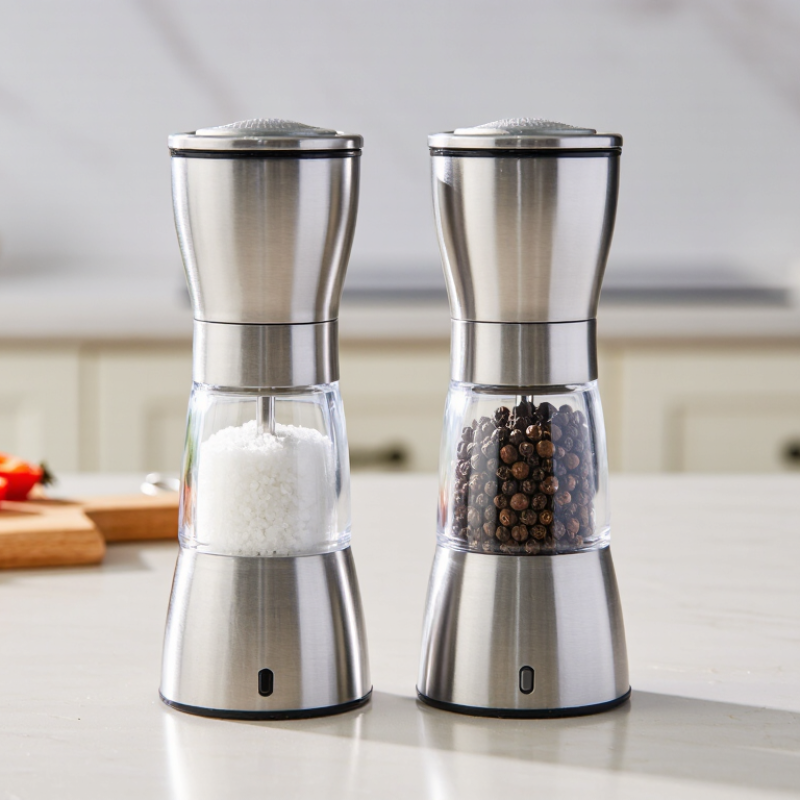
An electric salt and pepper grinder set is a pair of powered mills for seasoning food. Each mill holds salt or pepper in a refillable chamber and grinds it when activated. Most use a small motor, a grinding mechanism, and a button or tilt switch. Some models include a built-in light, which helps show where seasoning lands.
The grinding mechanism may use ceramic or metal components, depending on the design. A coarseness dial changes the distance between grinding surfaces, producing finer or larger particles. Battery-powered models are common, while rechargeable versions reduce the need for disposable batteries. Operation is simple. Press a button, or tilt the mill, and fresh seasoning falls onto the dish. A set can be useful when one hand is busy stirring or serving.
The details matter. Salt can absorb moisture, so a grinder needs a mechanism suited to salt and a chamber that stays reasonably dry. Peppercorns should fit without jamming the mill. Before choosing a set, check how it refills, how easily it adjusts, and whether parts can be cleaned. A supplier should be able to explain these specifications and describe basic quality checks. Still, no grinder is effortless: filling a narrow opening can be fiddly, and batteries may need replacing at inconvenient times.
A reliable electric salt and pepper grinder set begins with its grinding mechanism. Burrs or ceramic grinding elements should produce consistent particles, while a clear adjustment range lets users choose coarse flakes for steak or fine seasoning for soup. Motor strength matters too: weak torque can cause stalls when peppercorns are hard or the hopper is full. The European Spice Association’s Quality Minima Document sets a 12% maximum moisture level for black pepper. That matters in practice: damp pepper can clump, bridge over the grinding mechanism, and slow output. A sealed hopper helps, but it cannot compensate for poorly dried spices.
Performance also depends on details users notice at the table. A stable base, one-handed controls, and a bright light make seasoning easier over a hot pan. Battery life should be tested under repeated grinding, not just brief demonstrations. I would compare output across coarse and fine settings, then check whether the grind stays even as the hopper empties. A finer grind is not always better. It can release aroma quickly, but may also turn uneven if the mechanism heats or wears. This is a point worth testing, not assuming. Smooth operation matters. For suppliers, durable parts, easy cleaning, and clear instructions are as important as a polished exterior.
Choosing a Chinese supplier for an electric salt and pepper grinder set takes more than comparing unit prices. Ask whether the company manufactures the grinders or works through another factory. The distinction matters when a motor fails or a shipment arrives late. Request a production-line video, factory details, and a clear quality-control plan. Then compare those answers with a physical sample.
Check the parts that affect daily use. Does the grinding mechanism handle coarse peppercorns without frequent jams? Can the salt chamber resist moisture around a kitchen sink? Test the buttons with damp fingers, and listen for uneven motor noise. Small details reveal a lot. Ask for the battery type, charging method, food-contact material information, and available inspection records. Verify that documents match the exact model you plan to order.
Communication is another practical test. Send a short list of changes, such as a wider opening or a different grind setting, and see whether the supplier confirms each detail in writing. Ask about sample fees, minimum order quantities, production time, spare parts, and how defects are handled. A polished catalog can still hide weak follow-through. I would not judge a supplier by one perfect sample alone; repeat testing and independent inspection can catch issues that a quick demonstration misses.
A reliable electric salt and pepper grinder supplier should explain how each unit is checked, not just share a polished catalog. Request current production records, inspection criteria, and traceability details for motors, switches, batteries, and grinding mechanisms. Ask for records. Look for checks on grinding consistency, motor noise, button response, and burr alignment. A grinder that feels smooth in one sample may perform differently across a full batch.
Ask how the factory tests salt exposure and moisture resistance, since damp salt can clog a mechanism or affect metal parts. Request the test method and results, then confirm they apply to the model you plan to order. Verify certificates with the issuing organization when possible; a scanned document alone is weak evidence. Test the sample. Run several grinding cycles, check whether the adjustment setting holds, and inspect the battery compartment for loose contacts. A factory visit or independent inspection can reveal gaps between written procedures and actual assembly. Be realistic: a supplier may have good records yet still need improvement in packaging or final checks. Record those gaps, agree on corrective actions, and review a later production sample before confirming a larger order.
For a China electric salt and pepper grinder set supplier, compare landed cost, not just unit price. Request separate figures for the grinder, batteries, packaging, tooling, inspection, and freight. A low quote can hide costs. Ask how price changes at different order quantities, and whether replacement parts are available. Test sample units with coarse salt and peppercorns; motor strength and grind consistency matter in daily use.
Customization should be itemized: logo setup, color matching, packaging artwork, sample revisions, and minimum order quantity. Confirm the salt chamber’s capacity and whether the grind setting is adjustable before approving a sample. Small design changes can trigger new tooling or longer lead times. That part is easy to underestimate. Keep written approval records for color, materials, and packaging; a verbal agreement is weak protection when production begins.
Logistics deserve the same scrutiny. The World Bank’s 2023 Logistics Performance Index assesses 139 economies across six areas, including customs, tracking, and delivery timeliness. Ask suppliers for carton dimensions, gross weight, shipping terms, and recent on-time dispatch records. UNCTAD’s Review of Maritime Transport 2024 reports maritime trade grew 2.4% in 2023, amid route and freight uncertainty. Build schedule buffer into launch plans. A perfect quotation still cannot guarantee a smooth shipment.
| Selection dimension | What affects the decision | Useful checks and benchmarks | Questions to ask a supplier | Selection signal |
|---|---|---|---|---|
| Unit pricing | Motor, grinding mechanism, housing material, battery configuration, packaging, order quantity, and inspection requirements all influence the quoted price. | Compare like-for-like specifications and quantities. Request separate pricing for the product, packaging, tooling, samples, and any testing or inspection. | Which components and services are included? How does the price change at different order quantities? How long is the quotation valid? | A clear, itemized quotation makes cost comparisons more reliable than a single unexplained unit price. |
| Incoterms and landed cost | The quoted trade term determines which party arranges transport, handles export or import formalities, and bears specified costs and risks. | Request comparable quotations using the same named place and Incoterms® 2020 rule. Calculate freight, insurance, duties, taxes, and destination charges separately where applicable. | Is the offer EXW, FOB, CIF, or another term? Which named port or place applies, and which costs are excluded? | The supplier explains the delivery term precisely and helps prevent unexpected charges from being mistaken for product costs. |
| Customization | Options may include housing color, surface finish, grinding adjustment, light, button or gravity operation, gift box, and printed instructions. | Confirm which changes use existing components and which require new tooling or artwork. Approve a production-representative sample before mass production. | What are the minimum quantities, setup charges, sample charges, and approval steps for each requested change? | A practical supplier documents specifications, sample approvals, and change control before production. |
| Minimum order and production capacity | Minimum order quantities vary by model, component availability, packaging customization, and production setup; there is no universal MOQ for this product category. | Ask for the MOQ by configuration, sample availability, production schedule, and capacity for repeat orders. Verify the figures against the required delivery plan. | Can the order be split by color or packaging design? What is the confirmed production lead time after sample approval and deposit? | Capacity and lead times are stated in writing and are consistent with the supplier’s production plan. |
| Materials and food contact | The material and finish of parts that may contact salt or pepper should suit the intended use, storage conditions, and destination-market requirements. | Identify every food-contact part and request material specifications and applicable compliance documentation for the sales market. Requirements differ by jurisdiction and product construction. | Which parts contact food? What material grades and test reports are available for the exact model and finish? | Documentation matches the supplied model, materials, and destination market rather than a different product. |
| Battery and electrical compliance | Battery type, charging method, electrical design, and sales destination determine which transport and product-safety requirements may apply. | For lithium batteries, verify applicable transport documentation, including UN 38.3 test-summary availability where required. Confirm product compliance for each destination market. | What battery is included? Can the supplier provide the relevant test summary, safety documents, and accurate battery details for the shipment? | The supplier can identify the battery configuration and provide shipment and compliance documents that match it. |
| Quality assurance | Grinding consistency, motor performance, switch operation, leakage, finish quality, and packaging protection affect product reliability and customer experience. | Agree on written acceptance criteria, inspection stages, defect handling, and packaging tests before production. Use a pre-production sample as the reference where appropriate. | What functional and appearance checks are performed? Can inspection results and corrective actions be documented? | Quality expectations are measurable, recorded, and linked to an agreed sample or specification. |
| Shipping and packaging | Air, sea, and other available services differ in cost, speed, handling, and battery acceptance. Routing, season, carrier rules, and destination affect the actual schedule. | Request carton dimensions, gross weight, packing quantity, shipping mode, estimated transit time, and battery acceptance confirmation from the forwarder or carrier. | How is each grinder protected in transit? Are batteries installed, packed with the product, or shipped separately, and how does that affect carrier acceptance? | The supplier provides shipment-ready carton data and coordinates battery-related paperwork before booking. |
| Supplier verification and communication | Clear specification control, responsive communication, and traceable production records help manage sourcing risk. | Check business and export documentation, confirm who is responsible for manufacturing and quality control, and verify that samples and documents correspond to the quoted model. | Who handles production, quality, and export coordination? Can specifications, approvals, and order changes be recorded in writing? | The supplier provides consistent answers, model-specific evidence, and a written process from sample approval through shipment. |
Note: Pricing, minimum order quantities, lead times, and shipping costs vary by specification, order size, destination, and date. Obtain a current written quotation and verify destination-market requirements before placing an order.
Burr or ceramic grinding elements should make even particles at coarse and fine settings. Test both settings as the hopper empties. It can vary.
Damp pepper can clump above the grinding mechanism and slow output. The article cites a 12% maximum moisture level for black pepper. A sealed hopper helps, but cannot fix poorly dried spices.
Check for a stable base, one-handed controls, and a bright light near a hot pan. Test battery life through repeated grinding, not a brief demonstration. Small details matter.
Ask whether the supplier makes the grinder or uses another factory. Request factory details, a production-line video, and a quality-control plan. Compare these with a physical sample.
Grind hard peppercorns and check for jams, uneven motor noise, and responsive buttons. Try the controls with damp fingers. Salt chambers should also handle kitchen moisture.
Request current inspection criteria and traceability details for motors, switches, batteries, and grinding parts. Confirm that documents match the exact model. A scan alone is weak evidence.
Run several grinding cycles and check the adjustment setting, battery contacts, and burr alignment. An independent inspection may reveal assembly issues. Samples can mislead.
Clarify sample fees, minimum order quantities, production time, spare parts, and how defects are handled. Record requested changes, such as a wider opening. Get it in writing.
Note gaps in packaging or final checks, agree on corrective actions, and inspect a later production sample. Even good records can miss things. I would still retest.
An Electric Salt and Pepper Grinder Set combines motorized grinding with adjustable settings, making seasoning more convenient and consistent. Its quality depends on practical design choices, including comfortable handling, dependable motor performance, durable grinding mechanisms, easy refilling, and a construction that is straightforward to clean. Buyers should also consider whether the set offers useful features, such as adjustable coarseness and accessible controls, without adding unnecessary complexity.
When evaluating a Chinese supplier, buyers can compare manufacturing experience, communication, sample quality, production capacity, and willingness to support customization. Ask for relevant quality documentation and clear inspection procedures, then assess whether the supplier can maintain consistent standards across production runs. Pricing should be reviewed alongside materials, packaging, customization options, and order quantities rather than considered in isolation. Finally, confirm lead times, shipping arrangements, and how potential production or delivery issues will be handled before placing an order.